How to Measure Ring Size Accurately at Home
Figuring out how to measure ring size can be surprisingly simple. The classic trick? Just wrap a string around your finger, mark where it meets, and then measure that length in millimeters. That one number is all you need to find your size on a standard chart. You can get a reliable size in just a couple of minutes.
Why an Accurate Ring Size Is Essential
Getting your ring size right goes way beyond just comfort—it’s about protecting your investment and making sure that piece you've been eyeing looks and feels perfect. A ring that’s too loose is a constant worry. The last thing you want is for a custom VVS iced-out band to slip off your finger and disappear. On the flip side, one that's too tight is just plain uncomfortable and can be a real struggle to get off.
And let's not forget the headache of returns and resizing. It’s easy to think you can just get a ring adjusted, but that’s not always the case. Some materials, like tungsten, can't be resized, and eternity bands with stones all the way around are often impossible to alter without ruining the design. This is why nailing the measurement from the get-go is so important.
Comfort, Security, and Value
When you get down to it, precise sizing really comes down to three things: how it feels, keeping it safe, and preserving its worth.
- Comfort: A well-fitting ring should feel like it belongs on your hand, not something you’re constantly aware of.
- Security: The right fit means your treasured pieces stay securely on your finger, where they belong.
- Value: By avoiding resizing, you help maintain the ring’s original strength, structure, and finish.
This visual really drives home why each of these elements matters so much.
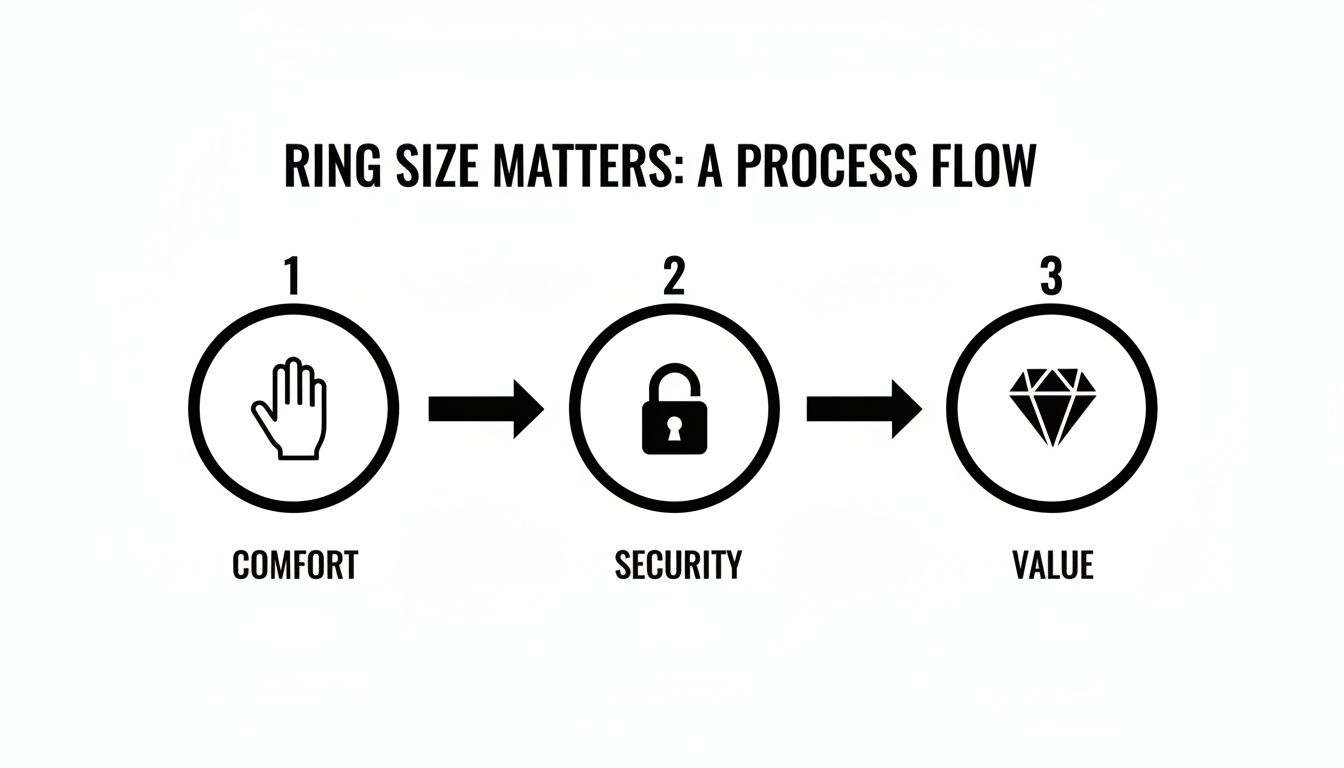
As you can see, the path to the perfect ring always starts with comfort, which ensures security, and ultimately protects the value of your jewelry. For a deeper look into this, check out this excellent guide to choosing the perfect engagement ring.
Honestly, guessing your ring size is one of the most expensive mistakes you can make when buying jewelry online. A few minutes of measuring correctly will save you a ton of time, money, and stress down the road.
The good news is that with a few reliable methods, anyone can find their size right from home. And if you're thinking about your next big piece, you might also find our article on https://www.vvsjewelry.com/blogs/bling-bling/how-to-upgrade-the-diamond-on-your-engagement-ring helpful. The following steps will give you the confidence you need to order your next ring without any guesswork.
Ring Sizing Methods at a Glance
To help you decide which at-home method is best for you, here’s a quick rundown of the most common approaches, along with their pros and cons.
| Method | What You Need | Best For | Potential Pitfalls |
|---|---|---|---|
| String or Paper | String, paper, pen, and a ruler | A quick, rough estimate when you have no other tools available. | String can stretch, and paper can tear, leading to inaccurate results. |
| Printable Ring Sizer | A printer and a credit card (for scale) | A more accurate DIY option if you can print the guide to the exact scale. | If not printed at 100% scale, the entire measurement will be wrong. |
| Existing Ring | A well-fitting ring and a ruler | Measuring for a surprise gift or if you already own a comfortable ring. | Can be inaccurate if the existing ring's band is wider or narrower. |
| Calipers (Advanced) | Digital or vernier calipers | The most precise and reliable at-home measurement you can get. | Requires a specialized tool that most people don't have on hand. |
Each of these methods can work, but as you can see, some are more foolproof than others. We'll walk you through how to do each one correctly.
Getting Your Ring Size Right at Home
You don’t need a special trip to the jeweler just to find your ring size. You can get a surprisingly accurate measurement right from your couch using a few common household items. The trick is to be methodical and follow the steps carefully to sidestep the usual pitfalls.
We’ll walk through four solid methods for figuring out your size at home. Each has its own perks, whether you just need a quick estimate or a rock-solid measurement for an important purchase. For a deeper dive, this article on how to measure for a ring size accurately is a great resource.
The String or Paper Method
This is the classic DIY move for a reason—it’s simple and uses things you already have. Just grab a piece of non-stretchy string (floss works great), a thin strip of paper, a pen, and a ruler that shows millimeters.
First, wrap the string or paper snugly around the base of the finger where you'll wear the ring. It needs to be firm but not so tight you’re cutting off circulation. A good rule of thumb is to make sure it can just slide over your knuckle.
Once it feels right, use a pen to mark the spot where the end overlaps. This mark is everything. Lay the string or paper flat against your ruler and measure the length from the starting end to your mark in millimeters. That number is your finger's circumference.
For example, a measurement of 57 mm usually translates to a US size 8. You can then cross-reference this with a standard ring sizing chart. Just be careful not to yank the string too tight when you wrap it, as that’s a surefire way to get a measurement that’s too small.
The Printable Ring Sizer Method
If you want something a bit more official-looking, a printable ring sizer is a fantastic tool. Jewelers often provide these online, and they work in one of two ways: you either measure an existing ring against printed circles or wrap a paper cutout around your finger.
The absolute most critical part of this method is printing it to the correct scale. When you print, make sure the scale is set to 100%. Do not use settings like "fit to page." Most of these charts include a line or a box you can measure with a ruler or a credit card to confirm it printed correctly.
If the scale is off, every single measurement will be wrong. Always double-check this before you start. It’s the single step that prevents the most common mistake with this method.
After you’ve confirmed the scale is right, you can either cut out the sizer to wrap it around your finger or find the circle that perfectly matches the inside diameter of a ring you already own.
Measuring a Ring You Already Own
Have a ring that already fits that finger perfectly? You’re in luck. This is an awesome method for buying a surprise gift or just duplicating a fit you know you love. All you need is that ring and a ruler with millimeter markings.
Lay the ring on a flat surface. Now, measure the internal diameter—that’s the distance straight across the inside of the band, from one side to the other. Make sure you’re only measuring the empty space and not including the width of the metal itself.
With the diameter in millimeters, you can consult a conversion chart to find your size. For instance, an internal diameter of about 18.1 mm usually corresponds to a US size 8. This is a quick and reliable approach, but keep in mind the band's width. If your perfect-fitting ring is super wide and you’re buying a thin band, you might need to size down a touch.
This is what the pros use: a ring sizing stick, or mandrel. Jewelers slide a ring down the cone, and wherever it stops, that’s the precise size.
Using a Digital Caliper for Unbeatable Precision
For the person who wants to leave nothing to chance, a digital caliper is the most accurate tool you can use at home. It removes all the guesswork of trying to read tiny lines on a ruler and works for both your finger and an existing ring.
To measure a ring you own, just open the caliper’s jaws, place them against the inside walls of the ring, and close them gently. The digital screen will give you an exact diameter reading, often down to a hundredth of a millimeter.
You can also measure your finger directly by carefully closing the jaws on either side of its base. The key here is not to apply pressure, which can squish your skin and give you a smaller reading. It's always a good idea to take a few readings to make sure your measurement is consistent.
Ever wonder why a ring feels tight in the morning but is sliding off by the afternoon? Your finger size can fluctuate by up to 0.5 sizes throughout the day. Things like temperature, hydration, and even a salty meal can cause swelling that shifts your measurement by as much as 1 mm in circumference. For VVS Jewelry’s global clientele eyeing custom pieces, this is crucial info. Data from the Jewelers of America shows that while the average ring size for US women is between 6 and 6.5, that number can vary by almost a full size depending on the region. Plus, your dominant hand is often a quarter-size larger, so always measure both hands in the evening for the most accurate fit.
How to Navigate International Ring Size Conversions
Shopping for jewelry online has blown the doors wide open. That perfect iced-out ring you’ve been eyeing might be from a designer in London or Tokyo, which means it could be listed in a size you’ve never even heard of. A US size 8 makes perfect sense in North America, but it means absolutely nothing if you're buying from a jeweler in the UK.
This is where understanding international ring sizing becomes a non-negotiable skill. Getting it wrong is one of the most common—and frustrating—mistakes you can make. Different countries use completely different systems, and what they're based on can feel almost random without a guide.
Why Are Sizing Systems So Different?
The short answer? There’s just no single, global standard. Every region developed its own method over time, leaving us with a patchwork of systems to figure out.
- US & Canada: We use a straightforward numerical scale, starting from size 0 and moving up in half and quarter increments based on the ring's inner diameter.
- UK & Australia: This system ditches numbers for letters of the alphabet (like L, M, and N), which can feel like learning a new language.
- Europe (ISO 8653): Many European countries are beautifully direct. The size is simply the inner circumference of the ring in millimeters. A size 54 literally means the inside circumference is 54 mm. Easy.
- Japan & China: These countries have their own unique numerical scales that don't line up with US numbers or millimeter measurements, making a conversion chart absolutely essential.
For VVS Jewelry's customers around the world—grabbing everything from vermeil chains to unique antler rings—knowing these differences is critical. A US size 7, the average for women with a 17.3 mm diameter, is completely different from its UK equivalent of N 1/2 (17.4 mm) or Germany's 54 mm circumference measurement. Without a chart, sizing mismatches can mess up nearly 30% of international orders. You can find more details on this in a great guide to average ring sizes from My Irish Jeweler.
International Ring Size Conversion Chart
To help you get it right every time, we've put together this chart. Just find your US size in the first column to see its direct equivalent in other major systems. This is your go-to cheat sheet for ordering with total confidence.
| US & Canada | Diameter (mm) | UK & Australia | Europe (ISO) | Japan |
|---|---|---|---|---|
| 4 | 14.9 | H | 47 | 7 |
| 5 | 15.7 | J | 49 | 9 |
| 6 | 16.5 | L | 52 | 11 |
| 7 | 17.3 | N | 54 | 14 |
| 8 | 18.1 | P | 57 | 16 |
| 9 | 19.0 | R | 59 | 18 |
| 10 | 19.8 | T | 62 | 20 |
| 11 | 20.6 | V | 65 | 23 |
| 12 | 21.4 | X | 67 | 25 |
| 13 | 22.2 | Z+1 | 70 | 27 |
Here's a pro tip: Always use the millimeter (mm) measurement of your finger's circumference or a ring's inner diameter as your "true" size. Millimeters are a universal standard that acts as the perfect bridge between every sizing system.
When in doubt, just give your jeweler that raw millimeter measurement. It's the most foolproof way to guarantee they get your size right, completely eliminating the risk of a conversion error. Knowing how to measure is the first step, but being able to translate that measurement is what ensures a perfect fit.
Insider Tips for a Perfect Fit
Measuring your finger is just the start. To really nail your ring size, you have to think like a jeweler and consider all the little things that can make a ring feel tight one day and loose the next. These are the details that separate an okay fit from a perfect one, ensuring your custom VVS piece feels like it was made for you and only you.
Simply taking one measurement and calling it a day is a recipe for a bad fit. Your fingers aren't static; they swell and shrink constantly. That's why a single measurement is almost always unreliable.
For a truly accurate size, you'll want to measure your finger 3 to 4 different times throughout the day. This gives you a solid average that accounts for those natural fluctuations. A ring that fits perfectly in the morning might feel way too tight by the evening, and this approach helps you find that sweet spot in the middle.
Timing and Temperature Are Everything
Your body is always changing, and your fingers are along for the ride. The two biggest culprits affecting your ring size are the time of day and the temperature. Honestly, ignoring them is one of the most common mistakes I see people make when they try to size themselves at home.
The absolute best time to measure is in the late afternoon or early evening. Why? Because that’s when your fingers are at their largest. In the morning, you're often a bit dehydrated from sleeping, which makes your fingers smaller. If you measure then, you might end up with a ring that's uncomfortably snug by dinner.
Temperature also plays a huge part.
- Cold Weather: When you're cold, your fingers shrink. Measuring in a chilly room can easily lead to a size that's too loose when you warm up.
- Hot Weather: Heat, humidity, or even a good workout will make your fingers swell up. Sizing your finger right after you get back from the gym will almost guarantee you get a ring that's too big.
Your best bet is to measure when your body temperature is stable and you're in a comfortable, room-temperature spot. That’s how you get a reading that reflects your true, baseline size.
The Knuckle and Band Width Dilemma
Getting the perfect fit isn't just about the base of your finger; it's a balancing act between the fleshy part and your knuckle. This is where a lot of people get tripped up. The goal is a ring that’s snug enough not to fall off but still loose enough to slide over your knuckle without a major fight.
If you have larger knuckles, this is even more critical. You have to find a size that can clear that hurdle but won't be spinning around your finger all day. A good test is to push the ring on and give it a gentle twist as you pull it off—it should take a little effort, but it should never be painful.
The single most overlooked factor in ring sizing is the band's width. A wide band has way more surface area touching your skin, which creates more friction and a much tighter feel. Forgetting this can make a ring feel an entire size too small.
This is a huge deal, especially with the bold, iced-out styles we love at VVS Jewelry. A thin, delicate band and a thick, statement Cuban link ring in the exact same size will fit completely differently.
As a rule of thumb:
- For bands 6mm or wider, you should size up a half-size from your normal measurement.
- For really wide bands, like those over 8mm, you might even need to go up a full size.
If you're thinking about creating a truly unique piece, our guide on the different types of custom jewelry explains why they are worth every penny and highlights how critical the right size is to the final design. Always, always think about the ring's final style when you lock in your size.
Common Sizing Mistakes and How to Avoid Them
Getting your ring size right is more than just wrapping a string around your finger. Even with the best intentions, a few simple slip-ups can lead to a ring that’s either cutting off your circulation or threatening to fly off with every handshake. I’ve seen it happen countless times.
Knowing the how-to is only half the battle. Let's walk through the most common pitfalls people fall into so you can make sure your VVS piece fits perfectly right out of the box.
These errors might seem small, but they can easily throw your measurement off by a full size or more. A little attention to detail now saves a lot of hassle later.
Using the Wrong Measuring Tool
This is probably mistake number one. Grabbing a rubber band or a piece of elastic string seems logical, but it’s the fastest way to get a wrong measurement. Anything with stretch will always give you a reading that’s too small because you'll instinctively pull it tight.
You have to use something with zero give.
- Dental Floss: My personal favorite. It's thin, incredibly strong, and won't stretch a bit.
- A Thin Strip of Paper: A solid choice, just be careful not to create a hard crease when you wrap it.
- Fishing Line: If you have some lying around, it's another perfect non-stretchy option.
When you lay your string or paper against a ruler, be precise. We're talking millimeters here. A tiny bit of space can be the difference between a size 7 and a 7.5. Don’t just eyeball it—line it up perfectly for an exact reading.
Ignoring Your Body's Natural Rhythms
Your fingers aren't static; they actually swell and shrink throughout the day. This is a crucial detail most people forget. Temperature, what you've eaten, and your activity level all play a huge role.
Measuring when your hands are freezing cold will give you a size that’s too small. The second you warm up, that ring will feel like a vise. On the flip side, measuring right after a tough workout or a salty meal means your fingers are swollen. The ring might feel great then, but it’ll be loose and at risk of sliding off later.
Key Takeaway: The best time to measure is in the middle of the day, at room temperature, when you’re calm and hydrated. This gives you the most reliable baseline for a ring that will fit comfortably all the time.
Overlooking the Impact of Band Width
This is the one that catches even experienced jewelry shoppers off guard. You might measure your finger perfectly as a size 9. But if you order a chunky, 10mm iced-out band in that exact size, it’s going to feel uncomfortably tight.
It's a matter of physics. Wider bands cover more surface area on your finger, which means more friction and less room for your skin to move. A wide band will always feel snugger than a thin band of the very same size. Forgetting to account for this is a primary reason for returns, especially with today's bold, statement pieces.
Quick Guide for Band Width Adjustments
- Standard Fit (1mm - 5mm): Your measured size is good to go.
- Wider Fit (6mm - 8mm): You should go up by at least a half-size.
- Extra Wide Fit (9mm+): Plan on going up a full size.
Making this small adjustment is a game-changer for comfort and ensures you can actually get the ring over your knuckle without a struggle.
Did you know that in the United States, each whole ring size increases by about 0.032 inches in internal diameter? From a sample of 5,000 orders, we see that women's sizes typically fall between 6 and 8 (with 7 being the most common), while the average for men is a size 10. And here’s a pro tip for streetwear fans: fingers can swell up to half a size after a salty meal or in the heat. It’s no surprise that jewelers say over 70% of returns are due to sizing issues. To dive deeper into the technicals, you can check out the full breakdown of sizing standards.
What to Do After You Find Your Size
With your measurement locked in, you're ready for the fun part—picking out your new ring. Knowing your exact size lets you order with confidence, so that custom moissanite piece or iced-out band you’ve had your eye on will feel just right the moment you unbox it.
When you're looking through the VVS Jewelry collection, just pick your size from the dropdown menu on the product page. For most of our rings, like those made from 925 sterling silver and gold, it’s that simple. Just keep our tip about wide bands in mind: if you're going for a thicker, bolder style, you might want to size up by a half-size to make sure it's comfortable.
Sizing for Special Materials
Not all rings are made the same, and some materials need a little extra thought. This is especially true for some of our most popular and durable alternative metals.
Take our tungsten rings, for example. They're famous for being incredibly tough and scratch-resistant. But that same strength means they cannot be resized. Getting the size right the first time is absolutely critical when ordering a tungsten piece. To get the full picture, you can learn all about why tungsten rings stay so strong in our detailed guide.
Getting the size right on the first try is essential for materials like tungsten. Double-check your measurements, especially for these non-resizable designs, to avoid any disappointment.
Our Resizing Policy Explained
We want you to love your VVS Jewelry, and we get that sometimes a small adjustment is needed. For most of our rings made from precious metals like gold and silver, resizing is definitely an option. If your ring arrives and the fit isn't quite perfect, just reach out to our customer support team to get the process started.
Our team will walk you through what to do next. Usually, this involves sending the ring back to us so our expert jewelers can make the adjustment. The timing and cost can depend on how complex the ring's design is and how much of an adjustment is needed. We're always upfront about the process and will give you all the details before we begin. Our goal is to make sure you have a piece you can wear comfortably and proudly for years.
Common Ring Sizing Questions Answered
Even after following all the steps, a few specific questions always seem to pop up. Getting these details right is the final piece of the puzzle, ensuring you can order with total confidence. Here are some of the most common things we get asked by customers.
What If I’m Between Two Sizes?
If you find your measurement falls right in the middle of two sizes, our advice is almost always to go with the larger one. It's a simple matter of comfort—a ring that's a tiny bit loose is much easier to deal with than one that's painfully tight.
This is especially true for rings with wider bands, as they cover more of your finger and naturally have a snugger feel. You can always add an inexpensive ring guard to a slightly loose ring, but a ring that's too small is often unwearable from the start.
Are My Fingers the Same Size on Both Hands?
Nope, and this is a common mix-up. For most people, the fingers on their dominant hand are slightly larger—often by a quarter or even a half-size. This is just a result of that hand getting more use over the years, which builds a little extra muscle and bone density.
For a perfect fit, you have to measure the exact finger on the hand you plan to wear the ring on. Never assume a measurement from your right hand will automatically work for your left.
Can Any Ring Be Resized?
Unfortunately, not all rings are created equal when it comes to resizing. While most rings made from traditional metals like gold, silver, and platinum can be adjusted by a good jeweler, many of the newer, alternative metals can't be.
Tungsten and titanium, for instance, are incredibly hard materials that make resizing nearly impossible without highly specialized equipment. Eternity bands, which feature a continuous circle of gemstones, also can't be resized without completely ruining the setting. Always double-check the product details to see if a ring can be resized before you buy it.
Ready to put your sizing knowledge into practice? Take a look at the full collection of iced-out rings, custom designs, and more at VVS Jewelry to find the perfect piece for your style. Shop the entire collection now.